
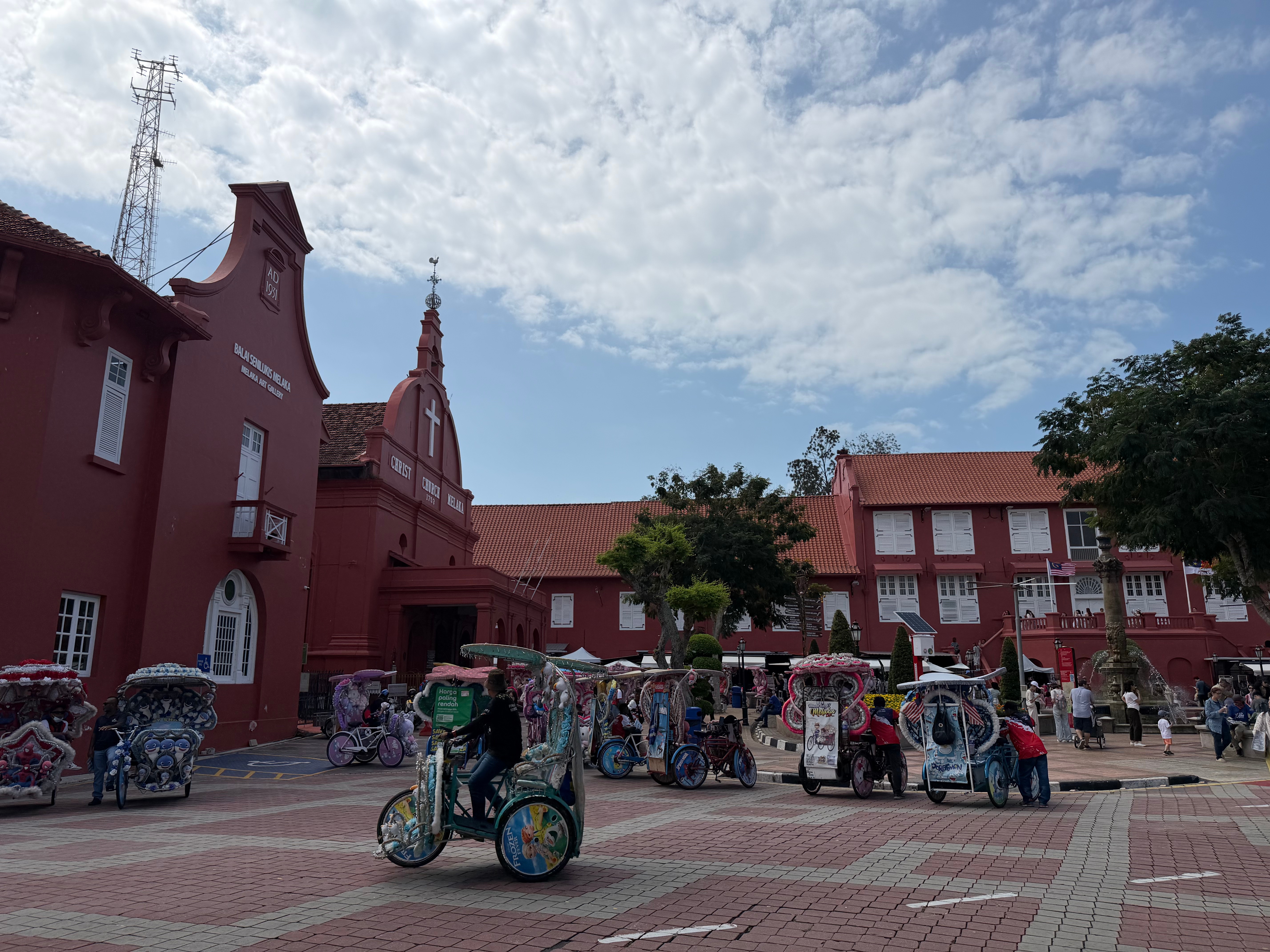
The Melaka Dutch Square is a reminder of the strong colonial presence of the Dutch (who built it) and the British (who painted it red) – and the rickshaws are a fun sight!
Melaka (Malacca) feels like a place where empires exhaled and left their stories behind. Portuguese, Dutch, British, Chinese, Malay – all of them left traces. You walk through them in a single afternoon: fortress ruins, wooden palaces, incense, river lights, and a night market that smells like grilled skewers and sugar.
This four-day Melaka itinerary is designed exactly for that kind of slow, layered trip. It’s built around Jonker Street, historic temples, riverfront museums, and sunsets over the Melaka Strait.
Table of contents
Day 1 – First Contact With Old Melaka
Morning: Jonker Street and Cheng Hoon Teng
Start where Melaka’s energy is loudest: Jonker Street, the heart of Chinatown and the city’s most famous walking street. By day, it’s a mix of antique shops, cafés, clan houses, and snack stalls – less neon, more texture. Wander without a plan, dip into side alleys, and let the smell of coffee or freshly baked tarts decide your stops.
Just a short walk away is Cheng Hoon Teng Temple, the oldest functioning Chinese temple in Malaysia, practising a blend of Buddhism, Confucianism, and Taoism. It’s a completely different pace from Jonker: red pillars, carved dragons, curling incense, and quiet prayers. This is where you feel how long Melaka has been a crossroads.
Afternoon: Sultan’s Palace and the Hill
After lunch, move up into the old royal and colonial core. Visit the Malacca Sultanate Palace Museum (Sultan Palace), a wooden replica of Sultan Mansur Shah’s 15th‑century palace with rooms full of weapons, royal regalia, dioramas, and stories from the Malay sultanate period. It’s one of the best places in Melaka to understand what existed here before the European forts and cannons arrived.

It’s also a great place to take shelter if the Malaysian rain starts pouring down!
From there, walk up the hill to the ruins of the Church of Saint Paul, once a Portuguese church and later used by the Dutch. The stone walls and open windows frame views over the city and the sea; it’s one of those places where you can literally see how strategic Melaka was.
Evening: Jonker Street Night Market
If you’re here on a Friday, Saturday, or Sunday, come back to Jonker Street for the Jonker Street Night Market. After 6 pm the road closes to traffic and transforms into a thick stream of stalls, sizzling woks, souvenirs, and live performances. It’s a very different Jonker from the daytime version! Entry is free, and the best way to do it is simple: snack, wander, repeat until midnight or your energy runs out. Keep some cash on you – Malaysia’s night markets are cash-only!
Day 2 – Forts, Museums, and the Strait
Morning: A Famosa Fort and the Hill Loop
Start at A Famosa Fort, or what’s left of it – Porta de Santiago, one of the oldest remaining European architectural structures in Asia. Stand here and imagine the Portuguese ships anchored in the strait, then the Dutch taking over, then the British – all trying to control the same stretch of water.
From here, it’s easy to loop back past the Church of Saint Paul if you want a different light and fewer people than Day 1. The walk between the fort, the hill, and the Sultan’s Palace creates a compact but powerful timeline of Melaka’s story.
Afternoon: Samudera Museum – Three Buildings of Maritime History
Head down to the Samudera Museum complex, often called the Melaka Maritime Museum. It’s spread across three main buildings, including the striking replica of the Portuguese ship Flor de la Mar (you can enter it!) and two adjacent museum halls. Inside, you’ll find ship models, trade route maps, maritime artifacts, and exhibits on Melaka’s role as a crucial trading port between East and West. It’s a great way to put all the “strategic location” talk into something visual and concrete.
Evening: Melaka Straits Mosque at Sunset
End the day at the Melaka Straits Mosque, built partly on stilts over the water and famous for its golden‑hour light. Time your visit for sunset when the mosque glows and the sky reflects off the strait. Dress modestly, move quietly, and give yourself enough time just to sit and watch the colors change.

We didn’t get a beautiful sunset because it was rainy season, but look at this view!
Day 3 – Temples, Settlements, and Stories
Morning: Qingshan Hou Wang (Er Gong) Temple & Bailong Wang Gong
Start the day with another layer of Chinese heritage at Qingshan Hou Wang (Er Gong) Temple & Bailong Wang Gong. This complex is less talked about than Cheng Hoon Teng but just as interesting – dedicated to local deities and community guardians. It adds to the picture of Melaka as a place where multiple belief systems have overlapped for centuries.
Afternoon: Portuguese Settlement and Kristang Culture
In the afternoon, head to the Portuguese Settlement, home to the Kristang people – a community of mixed Portuguese and Malay heritage. The enclave is known for its seafront restaurants, bright squares, and a unique blend of language, food, and Catholic tradition. If you’re here around lunch or early dinner, this is the place to try dishes like Debal Curry (Devil’s Curry) and fresh seafood that define Kristang cuisine.
This is also where you feel the human side of “Portuguese Malacca” – not just forts and cannons, but families, festivals, and hybrid identities that grew out of that history.
Evening: River or Jonker Repeat
By Day 3, you’ll probably have a favorite area. You can:
- Return to Jonker Street for another night market run (if it’s a weekend)
- Walk the riverside for quieter views
- Or find a café or bar you liked and sink into a slower evening
Melaka rewards repetition – the same streets feel different at different times.
Day 4 – Extra Depth and Open Time
Morning: Back to What You Loved
Use the last morning to revisit anywhere that felt important:
- Another slow visit to Cheng Hoon Teng Temple to notice details you missed
- A final loop through Jonker’s antique shops
- Or time inside the Sultan’s Palace museum if you rushed it earlier
This is also a good time for photos without the weekend crowds.
Afternoon: Flexible Time – Museums, Cafés, or Rest
Keep the final afternoon light. Depending on your energy, you can:
- Dive deeper into the Samudera Museum buildings if you skimmed them on Day 2
- Find a quiet café to write, read, or just people‑watch
- Wander aimlessly through side streets off Jonker, away from the main flow
Think of this as a buffer – Melaka is better when you’re not sprinting.
Evening: Closing the Loop
End your trip with one last meaningful stop:
- Sunset again at Melaka Straits Mosque if the weather cooperates
- A final dinner in the Portuguese Settlement with a table facing the water
- Or a slow walk through the historic core, saying goodbye to the places you’ve now walked through multiple times
The city doesn’t resolve into a neat conclusion – it’s more like a collage. Four days is just enough time for that collage to start making sense.
Practical Tips for Your Melaka Trip
- Jonker Street Night Market only runs Friday–Sunday evenings, roughly 6 pm to midnight. Plan your days so you’re in town for at least one of those nights!
- The main Jonker Street area is open daily and busiest around midday.
- Dress modestly for temples and mosques (covered shoulders and knees; bring a light scarf).
- Melaka is walkable in the historic core; use Grab or Maxim for jumps to the Portuguese Settlement and Melaka Straits Mosque.
- Museums and indoor sites are ideal for midday heat or tropical downpours; save hill climbs and mosque visits for early morning or late afternoon.
Leave a Reply